Tired of eating until you’re stuffed, only to see the scale barely move? For anyone trying to build muscle, the advice to “just eat more” feels both obvious and impossible. The real challenge isn’t just volume; it’s consistency and quality. This is where a smart system of meal prep for weight gain becomes your secret weapon, transforming your efforts in the gym into visible, hard-earned mass.
Forget force-feeding yourself bland chicken and rice six times a day. We’re talking about a strategic approach to food that fuels your body, respects your time, and actually tastes good. This guide will break down the science into simple, actionable steps, giving you the numbers, the system, and the recipes to finally build the physique you’re working for.
At a Glance: Your Blueprint for Gaining Quality Weight
Before we dive in, here are the core principles we’ll cover. Mastering these is the key to successful, sustainable muscle gain.
- Caloric Surplus is Non-Negotiable: You must consume more calories than your body burns. We’ll show you exactly how to calculate your target number without the guesswork.
- Macros Matter Most: It’s not just about calories, but where they come from. A strategic balance of protein, carbohydrates, and fats is crucial for building muscle, not just fat.
- Consistency is King: Hitting your nutrition goals one day a week won’t cut it. Meal prep ensures you have the right fuel on hand, every single day.
- Focus on Whole Foods: A “clean bulk” built on nutrient-dense, whole foods will support your health and lead to better quality gains than a diet filled with processed junk.
Why ‘Just Eating More’ Is a Flawed Strategy
When the goal is to gain weight, it’s tempting to hit the drive-thru and load up on calorie-dense junk food. While this will certainly make the scale go up, it’s a recipe for gaining unwanted body fat, feeling sluggish, and compromising your health.
The goal isn’t just to get bigger; it’s to get stronger and build lean muscle mass. This requires a caloric surplus, but a controlled one, built from high-quality nutrients.
Think of your body like a high-performance construction site.
- Protein is the bricks and mortar—the essential building blocks for new muscle tissue.
- Carbohydrates are the electricity powering the entire operation, fueling your workouts and helping you recover.
- Fats are the project managers, regulating hormones critical for muscle growth, like testosterone.
A diet of processed foods is like trying to build a skyscraper with cheap materials and an unreliable power grid. It might look big from a distance, but it lacks structural integrity. A well-planned meal prep strategy ensures your construction site has a steady supply of premium materials, every single day.
First, Nail Down Your Numbers: Calories and Macros
Before you chop a single vegetable, you need a target. Gaining muscle is a science, and it starts with knowing your specific energy needs. Let’s break it down into two simple steps.
Step 1: Calculate Your Daily Calorie Target
This three-part formula will give you a reliable starting point for your daily calorie intake. Grab a calculator and let’s find your number.
1. Find Your Base Calories (BMR):
This is the energy your body needs just to exist.
- For Men: Your current body weight (in pounds) x 11
- For Women: Your current body weight (in pounds) x 10
Example: A 150-pound man’s base calories would be 150 x 11 = 1,650 calories.
2. Factor in Your Activity Level:
Next, multiply your base calories by a number that reflects how active you are. Be honest here—overestimating will lead to excess fat gain. - Sedentary (little to no exercise): x 1.1
- Lightly Active (light exercise 1-3 times/week): x 1.3
- Moderately Active (moderate exercise 6-7 times/week): x 1.5
- Very Active (hard exercise 6-7 times/week): x 1.7
- Extremely Active (very hard exercise, physical job, 2+ workouts/day): x 1.9
Example: Our 150-pound man is moderately active, so: 1,650 x 1.5 = 2,475 calories. This is his maintenance level.
3. Add Your Surplus for Gaining:
This is where the growth happens. The size of your surplus depends on your training experience and current body fat. - For Beginners (less than 2 years of consistent training):
- Leaner Individuals (Men <10% BF, Women <20% BF): Add 300 to 1,000 calories. Start on the lower end and see how your body responds.
- Higher Body Fat (Men >10% BF, Women >20% BF): This is a special case. You may want to focus on “body recomposition” first. Consider a smaller surplus of 200-300 calories, or even eating at maintenance while ensuring protein is very high (at least 1g per pound of body weight).
- For Experienced Lifters (more than 2 years of consistent training):
- Leaner Individuals (Men <10% BF, Women <20% BF): Add 100 to 300 calories. Your muscle growth is slower now (“newbie gains” are over), so a smaller surplus is needed to minimize fat gain.
- Higher Body Fat (Men >10% BF, Women >20% BF): A slight deficit of 15% might be more appropriate, combined with very high protein (1.2g per pound of body weight) to slowly build muscle while losing fat.
Example: Our 150-pound man is a lean beginner. He adds a 500-calorie surplus: 2,475 + 500 = 2,975 calories per day. This is his target.
Step 2: Set Your Muscle-Building Macronutrient Targets
Now that you have your calorie goal, you need to determine where those calories come from. Here are the energy values for each macronutrient:
| Macronutrient | Calories per Gram |
|---|---|
| Protein | 4 calories |
| Carbohydrates | 4 calories |
| Fat | 9 calories |
| A proven macronutrient split for building lean mass is: |
- 40% Protein
- 35% Carbohydrates
- 25% Fat
Let’s calculate this for our 2,975-calorie target: - Protein: 2,975 x 0.40 = 1,190 calories / 4 = 298g of protein
- Carbs: 2,975 x 0.35 = 1,041 calories / 4 = 260g of carbs
- Fats: 2,975 x 0.25 = 744 calories / 9 = 83g of fat
A Simpler Protein-First Method:
If that feels like too much math, start here: Aim for 1 to 1.5 grams of protein per pound of your body weight. For our 150-pound man, that’s 150-225g of protein. Fill in the rest of your calories with carbs and healthy fats, and you’ll be on the right track.
The Four-Step System for Effective Weight Gain Meal Prep
With your numbers in hand, it’s time to build a system. The key to the Best Meal Prep for Weight Gain is a repeatable process that saves you time and mental energy during the week.
1. The Blueprint: Plan Your Week
Success begins before you ever turn on the stove.
- Choose Your Recipes: Pick 2-3 recipes for your main meals and 1-2 for snacks. You don’t need endless variety at first; consistency is more important.
- Schedule Your Meals: Decide how many meals you’ll eat per day (e.g., 3 main meals, 2 snacks). Divide your total calories and macros by that number to get per-meal targets.
- Make a Shopping List: Create a detailed list based on your chosen recipes. This prevents impulse buys and ensures you have everything you need.
- Time Your Nutrients: Plan your pre- and post-workout meals. A pre-workout meal, eaten 1-2 hours before training, should be rich in carbs for energy. Your post-workout meal should have fast-digesting carbs and protein to kickstart recovery.
2. The Execution: Batch Cook Like a Pro
Set aside 2-3 hours on a weekend day to get all your cooking done.
- Start with the Longest Cooks: Get rice, potatoes, or slow-cooker meats going first.
- Be Efficient: While those are cooking, chop all your vegetables. Then, cook your proteins (e.g., bake chicken breasts, brown ground beef).
- Use Your Oven: Baking is a fantastic, hands-off way to cook proteins and vegetables. Line a sheet pan with foil for easy cleanup.
- Embrace One-Pot Meals: Casseroles, chilis, and stews are easy to make in large batches and portion out.
3. The Payoff: Store for Success
Proper storage keeps your food fresh and safe.
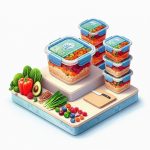
- Invest in Good Containers: Use airtight glass or BPA-free plastic containers. Clear containers help you see what’s inside.
- Portion Immediately: As soon as the food has cooled slightly, weigh and portion it into your containers. This removes any guesswork during the week.
- Refrigerate & Freeze: Most cooked meals will last up to 4-5 days in the refrigerator. If you prep for the full week, freeze the meals you’ll eat on days 6 and 7 to maintain freshness.
4. The Routine: Eat and Enjoy
Meal prep can get boring if your food tastes bland by day four.
- Reheat Smart: Microwaves are fast, but they can make food rubbery. For best results, reheat meals in a pan on the stovetop or in an oven/toaster oven.
- Add Freshness at the End: Don’t add sauces, salt, or delicate herbs before storing. Add them right before you eat. A squeeze of lime, a sprinkle of fresh cilantro, or a drizzle of hot sauce can bring a meal back to life.
Your High-Calorie Meal Prep Playbook: Recipe Ideas
Need some inspiration? This list of Meal prep for weight gain ideas should get you started on building delicious, calorie-dense menus.
Power-Packed Breakfasts
- Carrot Cake Overnight Oats: Combine oats, shredded carrots, protein powder, walnuts, and milk for a ready-to-go morning meal.
- Sausage and Egg Breakfast Casserole: A savory, high-protein bake you can slice up for the whole week.
- Croissant Breakfast Sandwiches: Prep the egg and sausage patties ahead, then assemble on a buttery croissant for a serious calorie boost.
- Pumpkin Protein Waffles: Make a large batch and freeze them. Just pop them in the toaster for a quick, muscle-building breakfast.
Calorie-Dense Lunches and Dinners
- Shredded Mexican Beef Bowls: Slow-cook beef chuck until tender, then serve with rice, black beans, corn salsa, and avocado.
- Chicken Alfredo Bake: A creamy, satisfying pasta dish that’s easy to make in a large batch and packs a caloric punch.
- Beef and Broccoli Stir-fry: A classic that combines protein, veggies, and carbs. Use a sauce with honey or brown sugar to add easy calories.
- White Bean Turkey Chili: A hearty, fiber-rich, and protein-packed meal that tastes even better the next day.
- Honey Garlic Chicken Thighs with Roasted Sweet Potatoes: Chicken thighs are more calorie-dense and flavorful than breasts, making them perfect for gaining.
- Salmon Teriyaki with Pineapple: Healthy fats from the salmon and quick carbs from the pineapple and rice make this a perfect post-workout option.
Smart Snacks and Smoothies
- High-Calorie Protein Smoothie: Blend whey protein, a banana, a tablespoon of peanut butter, a handful of spinach, whole milk, and a scoop of oats. This can easily top 600 calories.
- Vegan Energy Protein Balls: Combine oats, a plant-based protein powder, nut butter, and maple syrup, then roll into bite-sized balls.
- Double Chocolate Protein Muffins: A healthy way to satisfy a sweet tooth while getting in extra protein and calories.
- Chickpea Salad Sandwich: Mash chickpeas with Greek yogurt or vegan mayo and seasonings for a high-protein, plant-based snack.
Frequently Asked Questions About Gaining Mass
Let’s clear up a few common questions that come up on the journey to building mass.
How fast should I be gaining weight?
A sustainable rate of weight gain is about 0.5 to 1 pound per week. Gaining much faster than this almost guarantees that a significant portion of it will be body fat. Track your weight and your measurements. If your waist is growing much faster than your chest and arms, you may need to reduce your calorie surplus slightly.
What if I’m a “hardgainer” and just can’t eat this much solid food?
This is where liquid calories become your best friend. A high-calorie smoothie (like the one above) is much easier and faster to consume than a large plate of food. Also, focus on adding calorie-dense toppings to your meals: drizzle olive oil on vegetables, add sliced avocado to bowls, and sprinkle nuts and seeds on your oatmeal and salads.
Do I have to eat bland, boring food to see results?
Absolutely not! Lack of flavor is a primary reason people fall off their meal plan. Learn to use spices, herbs, and seasonings generously. A variety of low-calorie sauces like hot sauce, mustard, soy sauce, and salsa can make a huge difference. Don’t be afraid of marinades for your proteins.
Is it possible to do this on a budget?
Yes. You don’t need expensive steaks and fancy supplements. Build your plan around budget-friendly, calorie-dense staples:
- Proteins: Chicken thighs, ground turkey/beef, eggs, canned tuna, whey protein powder.
- Carbohydrates: Oats, rice, potatoes, pasta, beans.
- Fats: Peanut butter, whole milk, olive oil.
Your First Week’s Action Plan
Feeling motivated? Good. Knowledge is useless without action. Here is your simple, five-step plan to get started this week.
- Calculate Your Numbers (Today): Take 10 minutes right now to go through the formulas above and find your target calories and macros. Write them down.
- Pick 3 Simple Recipes (Tonight): Choose one breakfast and two lunch/dinner recipes from the list above. Don’t overcomplicate it.
- Make Your Shopping List (Tonight): Based on those three recipes, write down every ingredient you need for 5 days’ worth of food.
- Shop and Cook (This Weekend): Go to the grocery store. Then, set aside two hours to cook your meals for the week ahead. Put on some music or a podcast and get it done.
- Execute and Track (All Week): Eat the food you prepared. Pay attention to how you feel. At the end of the week, weigh yourself and assess. Did you hit your goals? Were you too full or still hungry? Adjust your plan for the following week based on that feedback.
The journey to building quality mass is a marathon, not a sprint. By trading wishful thinking for a solid plan, you give your body the fuel it needs to finally reflect the hard work you put in at the gym.

- Master Vegan Freezer Meal Prep to Simplify Your Busy Schedule - June 18, 2026
- Vegan Freezer Cooking Simplifies Healthy Meals on Busy Nights - June 17, 2026
- Vegetarian Freezer Recipes for Effortless Meal Prep and Delicious Dinners - June 16, 2026